Dear Editor,
Much has already been said about the upcoming vote to fund a new consolidated K-5 elementary school serving the north side of Wilmington with explanations of cost efficiency of upgrading three schools as one, strategic interleaving of debt with prior and future build projects, and the virtues of using this opportunity to reduce the environmental impact and transportation footprint of running three separate schools.
I would like to share 3 historical vignettes with quotes from town leaders which should resonate as much today for the Wildwood School replacement project as they did back in their own day when facing their own school facilities projects.
Vignette 1: 1887
School Committee Members Warren Eames, Othniel Eames, and Charles W Swain, in trying to get Wilmington’s very first multi-room school built for the High School class that had been holding class at the Town Hall (former Baptist Church) for the prior 15 academic years following a 12 year hiatus due to Wilmington’s lack of interest in funding secondary education:
“We had hoped in this report to be able to congratulate the town upon the completion of its new High School building, but that is still in the unfathomed abyss of possibility. We have urged its claims ever since the High School was established, and will close by saying, as we did in the report of 1872, that “we hope our town’s people will lay aside all party spirit, and unite in supporting such measures as will tend to build us up as a people, that Wilmington, fair in her natural proportions, may take her place in the front rank with her sister towns in whatever tends to promote education, morality, and true prosperity.”
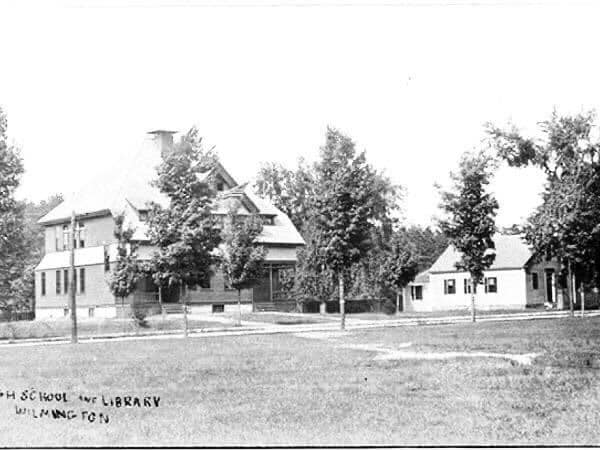
The “New Center School” at the left was built in 1888, when it replaced the one-room Center School, at the right. High School was held upstairs, and Common School (1-4) and grammar school (5-8) were held downstairs. The old one-room Center School building became the Library, now called the 4th of July Building, which is recognizable at the right.
Vignette 2: 1930s:
Supt. Stephen Bean, when the Jr High and High School had run out of space and were taking turns using the High School (a.k.a. Swain School) in double sessions, 3.5 hour morning session and 2.75 hour afternoon session. The plan for a gymnasium and 6 classrooms had stalled, but ultimately resulted in the Buzzell School being built:
1933: “It just seems as though the youngsters in the town haven’t a chance. Very little is done for them in comparison to what those in neighboring communities enjoy; no playgrounds, no gymnasium, no meeting place for social gatherings under proper guidance — it is little wonder that many of them regard school as a kind of penal institution.
1933: “We hear the cry that taxes are higher and hard to pay, that business is bad and employment scarce…What dollar produces as much value as the tax dollar? Surely, not the gasoline dollar, or the tobacco dollar, or the powder-lipstick-perfumery, marcel wave dollar, or the movie dollar, or any of the other luxury dollars which are the real heavy expenditures of the American people. It is time we forgot our pleasures and put a little thought into our safety and the future of society…The future of society depends on the training of young folks who are now in schools.”
1934: “This need is immediate. It is not a requirement which may eventuate in the future. It is present now and has been repeatedly called to the attention of the townspeople…Adverse influences were then able to cloud the issue and persuade the voters that the school authorities were false prophets. The people were persuaded that another fad in the form of a gymnasium was the main objective of the proponents of the high school addition. No consideration was given to the fact that six new rooms were also to be secured by the plan proposed. At that time the town was in much better condition financially to carry the project through. Within two years of the time that this endeavor was made the very conditions arose which had been prognosticated. Up to that time we had had a high school of which we were justly proud. If present conditions must continue the school must fall into a very low scale of rating.”
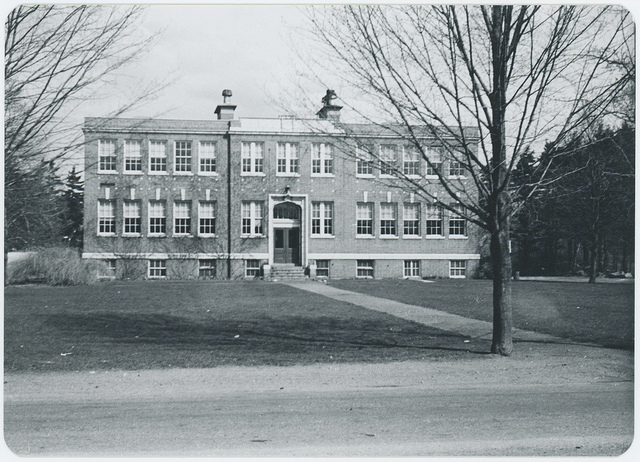
The “New High School” as they called it, was built in 1914, but had a host of problems. It was almost immediately undersized due to town growth, had a wet basement, and had a small room called a “gymnasium” with low ceilings in the basement. A proposal to add 6 classrooms and a real gym was proposed, but denied, and the Buzzell School was built instead to just meet classroom deficiencies in 1935. Thus Wilmington continued without a gymnasium and also without an assembly hall for the students until the 1950 High School was built. In 1956, it was renamed the “Swain School” after Caroline and Henrietta Swain, two sisters who had both been long-time elementary school teachers in town.
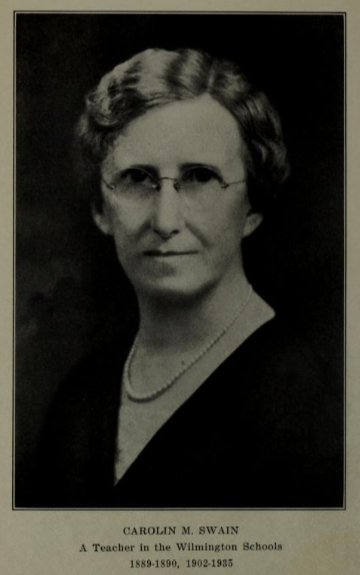
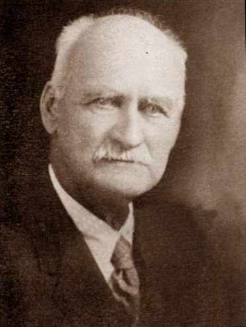
Caroline M Swain (left) and Dr. Daniel T. Buzzell (right), namesakes of two of Wilmington’s Schools.
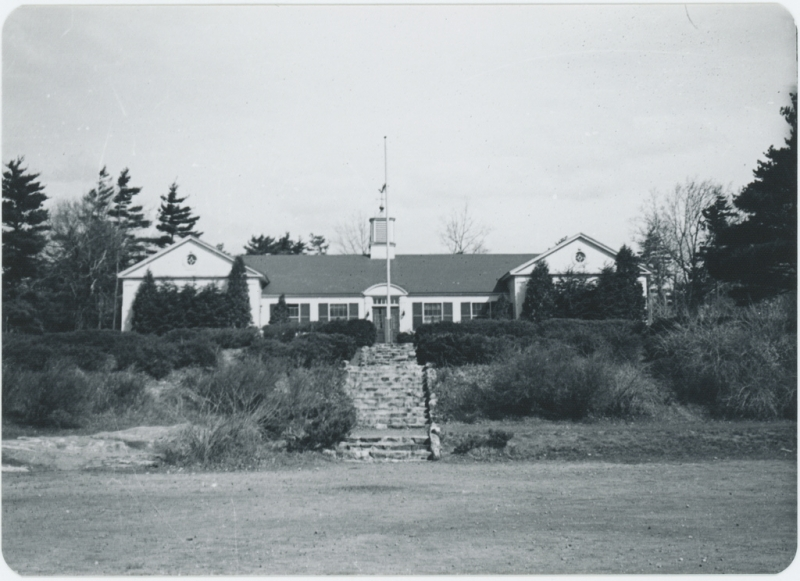
The Daniel T. Buzzell School was built in 1935 to house the 7th and 8th graders. They had been sharing the High School with the older students in two half-day platoons which was observed to be leading to the “loss of scholastic achievement” due to their 3-hour school day. Upon opening, the six classrooms at the Buzzell were immediately filled to seating capacity. This was also the first year Wilmington hired a gym teacher (“athletic instructor”).
Vignette 3: 1950s:
During our housing boom and baby-boom, the student population grew from 1,575 students in 1950, to 3,208 students in 1960, then to 5,097 in 1970. Wilmington’s all-time peak school enrollment was 5,522 in 1973. After the Wildwood was built in 1955, a strategic building plan was developed to help Town Managers Joseph F Courtney, Alfred Calabrese, Cecil O Lancaster, Gerald R Bouchard cheaply lead the town toward opening 5 new schools in the 7 years 1960-1966! (Glen Road, Boutwell, North Intermediate, Woburn Street, and West Intermediate)
1954: “Simultaneously we are entrusted with the broadest responsibility for managing the affairs of the Town and intelligently guiding its future development. …[This] is immeasurably complicated by the impact of the unanticipated growth of population and the resulting demand for services far beyond the financial capacity of Wilmington. The increasing cost of government constantly tends to exceed the available supply of new revenue to meet these obligations. The school situation alone illustrates the magnitude of the problem.”
1954: “From the vantage point of hindsight we can demonstrate that most of Wilmington’s difficulties today are traceable directly to the lack of planning in past years – a circumstance we share in common with other suburban communities on the “fringe” of metropolitan centers. This is not to imply criticism on those who exercised responsibility in other years – at best, the gift of prophesy is a rare talent, and is difficult to apply lacking adequate funds and facilities and a desperate sense of urgency.”
1957: “There are, however, some opportunities for the community to partially alleviate the crushing weight of school costs of which the most promising lies in the economical construction of new schools. Comprehensive proposals to achieve this end will be submitted to the 1958 Annual Town Meeting. By drawing upon the General Plan studies to forecast when and where schools will be required, and by the determined application of standard plans and specifications so as to deliberately minimize the unit cost of school construction, it should be possible to accomplish this without detracting from a sound educational program.
1958: “Perhaps one of the most significant steps taken in 1958 to meet the ever present threat of rising costs was the start of construction on the Glen Road School which demonstrated that “good” schools are possible at construction cost levels within our “ability to pay.
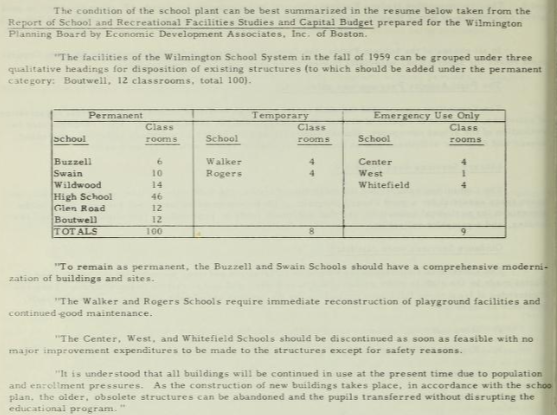
In 1959, the schools were stressed due to the huge demand and several school buildings that were old and failing were pressed into service (Walker, 63 years, Whitefield 55 years, Center, 71 years, West, 84 years one-room). (1959 Town Annual Report)
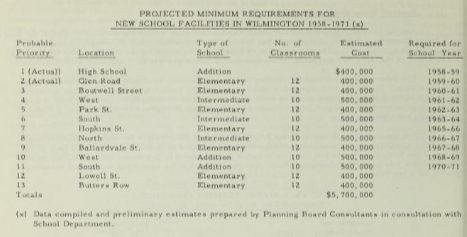
The planned response from the School department was basically one low-cost building project every year until the school demand was fully satisfied. Note that the Glen Road and Boutwell cost about $400K, but by the time the North (1962) and West (1966) Intermediate Schools were actually built, the building costs had more than doubled the estimates from 1959 to over a million dollars each. (1959 Town Annual Report)
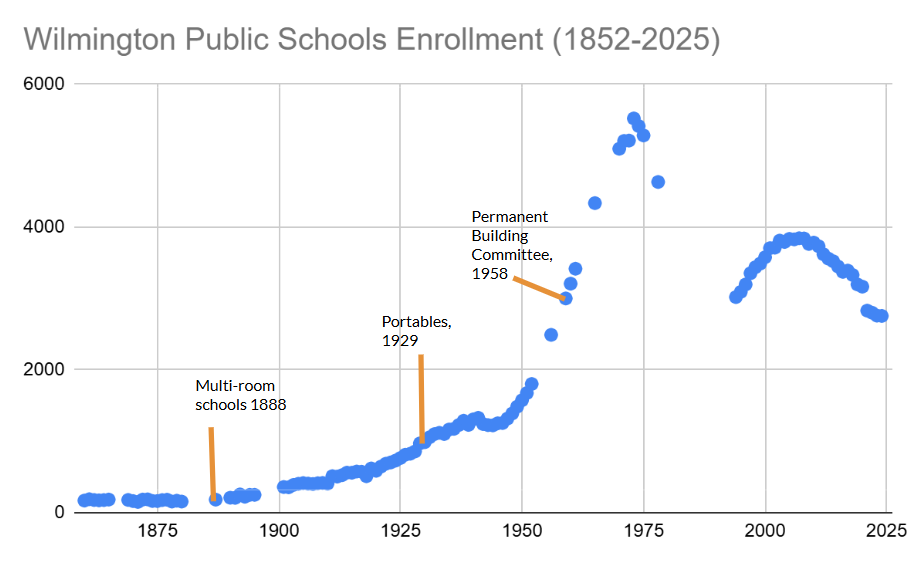
The incredible boom in population in the 1950s and 1960s led to Wilmington needing to rapidly build schools as cheaply as possible to meet the classroom and facility demands. These schools include the 5 schools currently serving our elementary students. Boutwell (1961), North Intermediate (1962), Woburn Street (1963), West Intermediate (1964), Shawsheen (1970).
Summary and Observations
I hope that these three vignettes might impress upon our fellow citizens that our sentiments of today are echoes of our forefathers observations. We are facing the need to unify and show up to the vote, just like 1887, when our first multi-room school required much cooperation across differing opinions. We need to understand the generational impact of the average $35 per month tax implications, just as the 1930s need for a school, whose gymnasium proposal was being labeled an unnecessary fad-based expense, and budget impacts of choosing to delay were getting worse year by year.
We are attempting to economize with our strategic plan to solve 3 schools worth of issues over 8 years of planning and implementation for a single building project, in response to the 1950s plan that led to our 5 cheap elementary and intermediate schools being built in a single decade. Furthermore, the comprehensive plan prepared by Wilmington’s committees and leadership for 2025 and beyond implements a strategy for funding comprehensive school improvements over the next 50 years, of which this building project is just one.
Please join me in helping stay on track by voting YES to funding this school building on the ballot measure and at the Special Town Meeting (9/13/25).
Joseph A Jackson
Like Wilmington Apple on Facebook. Follow Wilmington Apple on Twitter. Follow Wilmington Apple on Instagram. Subscribe to Wilmington Apple’s daily email newsletter HERE. Got a comment, question, photo, press release, or news tip? Email wilmingtonapple@gmail.com.

