Below is a press release from the Public Health Museum:
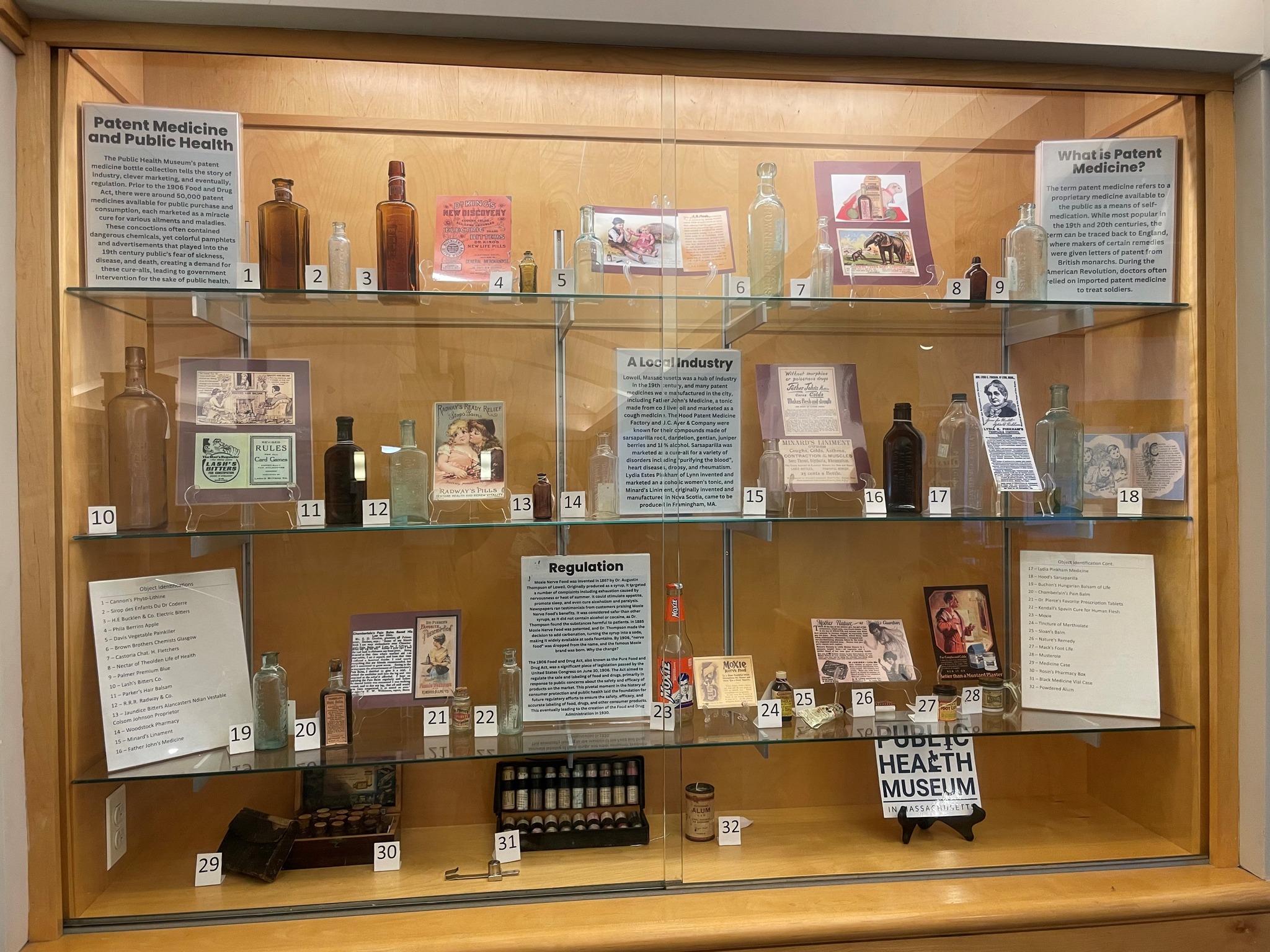
TEWKSBURY, MA — The Public Health Museum in Massachusetts is pleased to announce the installation of a temporary exhibit at the Tewksbury Public Library of portions of its Patent Medicine exhibit. The museum, located in Tewksbury, Massachusetts, arranges a variety of events for the public to learn more about the role public health plays in daily life. The exhibit will run until July 31, 2023.
Patent Medicine and Public Health
The Public Health Museum’s patent medicine bottle collection tells the story of industry, clever marketing, and eventually, regulation. Prior to the 1906 Food and Drug Act, there were around 50,000 patent medicines available for public purchase and consumption, each marketed as a miracle cure for various ailments and maladies. These concoctions often contained dangerous chemicals, yet colorful pamphlets and advertisements that played into the 19th century public’s fear of sickness, disease, and death, creating a demand for these cure-alls, leading to government intervention for the sake of public health.
What is patent medicine?
The term patent medicine refers to a proprietary medicine available to the public as a means of self-medication. While most popular in the 19th and 20th centuries, the term can be traced back to England, where makers of certain remedies were given letters of patent from British monarchs. During the American Revolution, doctors often relied on imported patent medicine to treat soldiers.
A Local Industry
Lowell, Massachusetts was a hub of industry in the 19th century, and many patent medicines were manufactured in the city, including Father John’s Medicine, a tonic made from cod liver oil and marketed as a cough medicine. The Hood Patent Medicine Factory and J.C. Ayer & Company were known for their compounds made of sarsaparilla root, dandelion, gentian, juniper berries and 18% alcohol. Sarsaparilla was marketed as a cure-all for a variety of disorders including “purifying the blood”, heart diseases, dropsy, and rheumatism. Lydia Estes Pinkham of Lynn invented and marketed an alcoholic women’s tonic, and Minard’s Liniment, originally invented and manufactured in Nova Scotia, came to be produced in Framingham, MA.
Regulation
Moxie Nerve Food was invented in 1867 by Dr. Augustin Thompson of Lowell. Originally produced as a syrup, it targeted a number of complaints including exhaustion caused by nervousness or heat of summer. It could stimulate appetite, promote sleep, and even cure alcoholism and paralysis. Newspapers ran testimonials from customers praising Moxie Nerve Food’s benefits. It was considered safer than other syrups, as it did not contain alcohol or cocaine, as Dr. Thompson found the substances harmful to patients. In 1885 Moxie Nerve Food was patented, and Dr. Thompson made the decision to add carbonation, turning the syrup into a soda, making it widely available at soda fountains. By 1906, “nerve food” was dropped from the name, and the famous Moxie brand was born. Why the change?
The 1906 Food and Drug Act, also known as the Pure Food and Drug Act, was a significant piece of legislation passed by the United States Congress on June 30, 1906. The Act aimed to regulate the sale and labeling of food and drugs, primarily in response to public concerns about the safety and efficacy of products on the market. This pivotal moment in the history of consumer protection and public health laid the foundation for future regulatory efforts to ensure the safety, efficacy, and accurate labeling of food, drugs, and other consumer products. This eventually leading to the creation of the Food and Drug Administration in 1930.
About The Public Health Museum
Through artifacts, memorabilia, and archival materials, the museum explores the history of public health in America and the story of Tewksbury Hospital, one of the first public health hospitals in the country. Started as an almshouse in 1854, the hospital was home for a short time to Anne Sullivan, Helen Keller’s teacher.
Museum exhibits include Infectious Diseases, Patent Medicines, Food Safety and Pasteurization, early Mental Health, Nursing/Education, and early Dentistry. Well preserved WPA art posters and murals frame the museum’s walls. The museum also features an iron lung; a lifesaving machine for those stricken with polio.
Tours are by reservation. Please visit the museum sign up for dates and times at https://bit.ly/3myD75o
To view the exhibit, visit the Tewksbury Public Library, 300 Chandler Street, Tewksbury, Monday through Wednesdays, 10:00AM-9:00PM, and Thursday/Friday, 10:00AM-5:00PM. The library is closed on weekends through the summer.
Like Wilmington Apple on Facebook. Follow Wilmington Apple on Twitter. Follow Wilmington Apple on Instagram. Subscribe to Wilmington Apple’s daily email newsletter HERE. Got a comment, question, photo, press release, or news tip? Email wilmingtonapple@gmail.com.
 Wilmington Apple