WILMINGTON, MA – Residents of North Wilmington came out in force at Monday night’s Board of Selectmen Meeting to oppose the construction of a proposed detox center in the vacant lot across from Pizza Mia.
The project’s team – substance abuse expert David Ray, builder Paul Kneeland, and community liaison Michael Caira – made a thorough presentation to the board and the public. After the Selectmen offered their comments, more than 30 residents took to the mic to ask questions and share their thoughts.
Discussion lasted approximately 3.5 hours and began with Wilmington Town Manager Jeff Hull explaining why the presentation was happening.
“I received a call back in August from Mike Caira, asking if there’d be an opportunity to meet with a gentleman who was interested in putting a substance abuse detox center in North Wilmington,” began Hull. “I had no objection to listening to the proposal. I asked department heads who might have an interest to participate in that internal staff meeting, which was held on August 16.”
“At the conclusion of that meeting, it was agreed that this would be brought forward to a Board of Selectmen Meeting,” explained Hull. “The proponents have not yet gone to any of the permit granting authorities (Planning Board & Board of Appeals). The intent was really to first have a discussion with staff and then the Board of Selectmen to get a sense if this is something that these groups would consider viable, and to provide an opportunity for the public to hear about it.”
“There’s been a suggestion that this is a done deal and that there’s been some behind-closed-door deals. Nothing could be further from the truth,” said Hull. “No one on the staff level or any elected official has endorsed this proposal. We’re here tonight to hear about it, ask questions, and offer comments.”
The Proposal
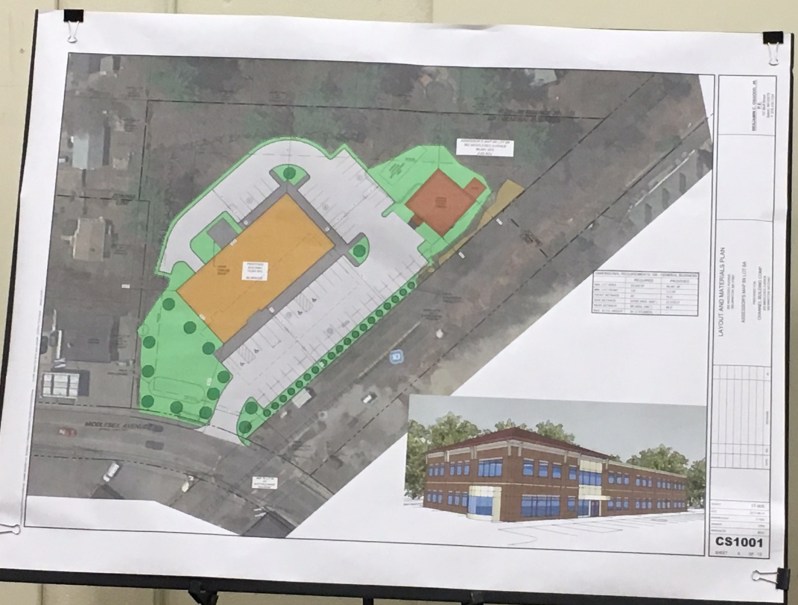
A 48 bed co-ed clinical detox and short term residential facility is being proposed for 362 Middlesex Avenue. The brand new 20,000 square foot building would look like a modern medical building and provide a high level of clinical care provided by doctors, nurse practioners, RN’s, psychiatrists, and case managers. The facility is NOT a methadone clinic, halfway house, sober living facility, or “come and go facility.”
Clients would remain in the facility, on average, for the 10-14 days. Visitors would not be permitted during a client’s stay. There will be a minimal number of clients checking in and out, with minimal impact on traffic. The handout cited a John Hopkins study published in The Journal of Studies on Alcohol and Drugs that shows “clinical facilities of this nature do not impact communities any more than any other commercial business with respect to crime, and – in fact – less than many other permitted uses for this property.”
Wilmington would uniquely benefit from this facility in four key areas:
- Wilmington residents would be given top priority for admission.
- A community room would include in the facility and host weekly family meetings for families in Wilmington and neighboring towns to help provide guidance on how to help an addict.
- Wilmington residents would receive first priority and opportunity for jobs. A private, Wilmington job fair would be held.
- The facility would provide a powerful in-town addiction resource for the school system, police and health departments, giving insight and assistance to local town and school officials on how to battle the addiction epidemic.
Former Town Manager Michael Caira, who is serving as an unpaid community liaison for the project and has no financial interest in its outcome, began the presentation by explaining his involvement.
“I got involved in this project for a number of reasons,” said Caira. “Most importantly, I’m tired of going to wakes and funerals. I’m tired of talking to friends who have lost family members, particularly sons and daughters… 4-6 young people a year are passing away from substance abuse in this community. This is about the people we love.”
“During the Vietnam War, Wilmington lost four people…. I knew them all,” pointed out Caira. “From 2012 to 2016, 24 people from Wilmington suffered an opioid-related death, and that’s just the ones we know about it.”
“We recognize there’s a neighborhood that feels affected by this proposal and is concerned by its location,” acknowledged Caira. “That’s why we want to tell you just what this proposal is. I understand the Board of Selectmen isn’t asked to take a vote. We’re here because they provide the single best, most transparent forum for us to come forward and present.”
“I looked at this project the same way I would have looked at a project as Town Manager. I checked it out,” assured Caira. “I looked at what I believed this center has to offer. I looked at the background of Mr. Ray, which took me to Wakefield. Rather than hear from me, we’ve provided references from folks in Wakefield. I encouraged the Town Manager, Police Chief and Health Director to talk to their counterparts in Wakefield and see what they had to say.”
David Ray, the brainchild behind the proposal, discussed his personal and professional background. Highlights included:
- Grew up in North Reading. Father was a pastor. Became interested in religion. Got an undergrad and masters in theological studies in California. Became an assistant pastor at a church in Beverly Hills. Developed a drinking problem and became a “savage” alcoholic.
- Moved back to Boston. Graduated from Northeastern law school. Lived in Wilmington (Westdale Avenue) for a period of time. Moved back to LA and became a lawyer for 21st Century Fox. Drinking problem progressed. Arrested for a DUI while driving to work at 9am. His father “saved him” and brought him home.
- Went to a “wonderful” treatment center called the Plymouth House in New Hampshire. Gave up his ability to practice law and started a non-profit to help men and women overcoming drinking and using drugs.
- While Ray currently lives in Florida, he would likely move to Wilmington with his family to take a “hands-on approach” and be on “the ground level.”
Ray stressed several points during his presentation:
- The opioid epidemic is going to get worse before it gets problem. “We’re probably eight years away from the peak. It’s going to get a lot worse.”
- Before receiving treatment, an addict needs detox to be weaned off the substance. This is a medical event that’s synonymous with what would happen in a hospital. The next stage is short-term stabilization, where medical professionals would stabilize the individual and make a plan and referrals based on the patient’s particular needs.
- Staff will promote a 6-to 9-month treatment plan for patients. The center serves as the first two steps in a very long recovery process.
- Clients will have zero interaction with the community. They’ll be transported to the facility, pull up to the front door, go inside the facility, and the next time they step out, they’ll go into a vehicle to their next facility. “They want a very private place to do a very private, and in their mind, shameful thing.”
- The maximum in-take, out-take per day at the facility would be 3 in and 3 out.
“In many respects, it would be like Wilmington would have its own detox center,” said Ray. “We can’t help the families of Wilmington, the mothers of Wilmington, the first responders of Wilmington unless there’s cooperation and acceptance. That’s why we’re here tonight – to begin to educate people.”
“I live in North Wilmington. My office is across the street. My intention is to make this a first-class facility,” added Paul Kneeland, of Channel Building, who would be tasked with its construction.
Speakers Opposed To The Proposal
“I support a facility within this community, but I’m vehemently opposed to the proposed location, which borders a densely populated neighborhood. This would be in my backyard – literally, in my backyard,” said direct abutter MJ Byrnes. “My family is looking at a dramatic reduction of property values, up to 17% of our home value. In real numbers, that’s $80,000-$90,000. No resident should be expected to take a loss at this time, regardless of the business that causes it…. Let’s find a reasonable solution together as there is a lot of commercial realty available in Wilmington.”
“Having a facility like this, literally in backyard, will affect taxes, insurance, resale potential, and property values,” said neighbor AJ Silva, who also expressed safety concerns based on his experience as a paramedic. “People can sign themselves out and hit the street. The same streets where my sons ride their bikes. The same streets where I walk my daughter to the library. These particular addicts will seek out and find places to hide, relapse, and possibly die. Is this something you want our children to come across?”
“People [dismiss] ‘Not In My Backyard’ complaints, but when it’s $100,000 of your own pocket, it’s a different story,” said direct abutter Joe Byrnes, who serves in law enforcement. “From a safety viewpoint, I worry that a person could walk away or escape and immediately be in my backyard or in my neighbors’, many of whom have small kids or are elderly.” Byrnes also noted the ambulances will be heard at all times of the night, and “quite a bit of traffic” will be generated by the 60 employees, plus vendors associated with food and laundry.
“I feel a detox center would be a huge benefit to Wilmington, but this isn’t the right place. There’s a school bus stop right next to this location… I want to keep my kids as innocent as I can,” said Oakdale Road resident Joan Mularkey. “If anything, Wilmington needs a bigger detox facility. There are a lot more appropriate sites in Wilmington that could accommodate a building double or triple in size.”
“This program is not proposed for the right spot,” said Pinewood Road resident Briane Santo. “I have three small kids and I’m trying to let my children be children… There are other sports in Wilmington. This would not be the best choice.”
“Why pick a main street if the facility and clients want privacy? It’s just the wrong spot,” said Frederick Drive resident Jeff Wood.
“I’ll advocate and volunteer for this facility, but at another location,” said Shady Lane Drive resident Kimberly McNeely, who just moved to town two weeks ago. “There’s nothing but children in our neighborhood. I don’t want my kids around this.”
“I think you need a bigger facility,” said Oakwood Road resident Joe Xavier. “If we’re going to make this happen, let’s make it in a bigger site that will service more folks.”
“It frightens me that [the patients] can leave whenever they want to. We don’t know where they’re going to go. It’s scary to think about,” said Shady Lane Drive resident Kaelan Richards. “We can find a better place for this here in town… And the residents speaking in favor of this project wouldn’t have a problem if it was moved to a better location.”
“You’re trying to provide a great service, but this doesn’t belong in North Wilmington,” said Park Street resident Mike Shay. “You’re putting residents in harm’s way.”
“I’m concerned about security and people leaving the facility and entering our neighborhood. I’d give my right arm to help, but not my child’s right arm,” said Pinewood Road resident Cheryl Slater, who works as a nurse. “As a nurse, we’re taught you don’t put yourself or others at risk to help other people… Let’s work as a community to find the right spot for this.”
“As a community, there has to be a way where we can all benefit from this and no one has to suffer… We welcome you and this idea, but we want to work together and find a location that would satisfy everyone. There’s plenty of open space in Wilmington. This can’t be on the only location,” said Judith Road resident Jackie Rebeiro. “We are N.I.M.B.Y. We DON’T want this in our backyard. I work two jobs to move here for my family and my kids. I don’t want to move or take a hit on my property. Let’s come together as a community and find a location where everyone can benefit.”
An additional five area residents spoke, including Pinewood homeowners Jon McGrath and Ed Coughlin, who also raised security concerns.
Speakers In Favor Of Letting The Process Continue
“I’m 100% for this facility,” said resident Mary Giroux, a local real estate agent and a mother who lost a child to addiction. “I know you all worked very hard for your homes and they’re your investments. A bigger investment, however, is your children… You can’t place a value on human life… If this was another kind of illness, none of you would be upset about your property values. There’s a stigma attached to this affliction… You’re all afraid they’re going to escape, break into your house, and steal your jewelry, but they’re already doing this because they don’t have treatment… It’s not OK to let people die. Really reflect on that. You’re not going to lose so much money on your home. This is way more important than that.”
“Thank you for thinking of Wilmington and wanting to come here to help Wilmington,” said resident, former Selectmen, and Veterans Agent Lou Cimaglia. “I deal with addiction everyday. I bury way too many of my own veterans… I believe the intentions here are nothing but good. I hope it works out. It’s going to be a tool in my toolbox that I’m going to use. It could certainly save lives.”
“I understand people’s concerns about the location, but we need to look at the big picture,” said resident and former Selectman Judy O’Connell. “We need to keep an open mind and avail ourselves to the regulatory process and see this through… We have a serious issue. If we all just look away and hope the next town takes this issue on, we’re going to be in serious, serious trouble… If we forgo this opportunity, I don’t know when the next opportunity will come.”
“What troubles me is the comments about appraisals… I’d be outraged if this was the reason presented in arguing against a facility for, say, autistic adults. I’d be beside myself,” said Middlesex Avenue resident and former Selectman Michael Newhouse. “I would just respectfully caution the town that arguing appraised values would be affected by a protected class of people living in a neighborhood is probably not the reason the town would want to use to prevent this development.”
“Thank you, thank you, thank you. The town needs this. I lost a house because of addiction. Thankfully, I didn’t lose a person, just a house,” said resident Linda Scifo, whose granddaughter is a heroin addict. “There a lot of addicts out there. They look like you and me and our children. It’s an epidemic. Wilmington needs help. Thank you from the bottom of my heart.”
“I think this location works. Addiction thrives in the shadow. Let’s kill it in the spotlight,” said resident Michael Gray. “We should be saying to [the proponent], ‘What can we do to help?’… We need this…. And let’s not refer to those he’s trying to help as ‘these people.’ Let’s treat them as human beings, as patients with rights.”
”If these were veterans fighting a war, we’d be saying – let’s open this place. These folks are fighting their own sort of war,” said Derek Fullerton, a Wilmington native and President of Massachusetts Health Officer Association. “I get texts from Wilmington residents each month looking for assistance… Please make me proud to be from Wilmington and support this.”
“Here and now, we have this land, this building, and this gentleman willing to embark on this project. At the very least, it’s something we ought to consider,” said Brady Foundation co-founder Sylvia Fitzpatrick. “Thank you for considering this. It’s an amazing opportunity that really a lot of people can benefit from,” added Brady Foundation co-founder and Wilmington native Renee Marcou.
Additional Speakers
“The Police Department needs assistance. We need help. We fight the struggle everyday. I understand and sympathize with the folks who live in the neighborhood. My concern is – there aren’t a bunch of people knocking on our door that want to help Wilmington specifically,” said Wilmington Police Chief Michael Begonis.” “I’m not here to tell you if this is the right location, but we need [this facility] and we need it now… From a police department perspective, this is something we really need to consider. We could really use a hand.”
“I’ve spoken to the Police Chief in Wakefield and there have been no issues with [Ray’s] Wakefield facilities. I’ve spoken to other chiefs that have detox centers. They don’t seem to have a lot of issues either,” added Begonis.
“I’ve spoken with the Town Manager in Wakefield about [Mr. Ray’s] two different facilities – one was very close to a school, one was in a residential area,” said Wilmington Town Manager Jeff Hull. “He said, at the outset, there was concern about potential issues, but there never were any issues that he was aware of.” Hull said the Wakefield Town Manager called Mr. Ray a “good business person” who was “invested in the community.”
Dave Robertson, State Rep. Jim Miceli’s Chief of Staff, noted he had been sent on a fact-finding mission at the meeting. He asked if any other plots of land had been considered for the facility. (The answer was no.) Robertson also asked that IF the town’s zoning bylaws needed to be amended to allow a detox center be located in an industrial zone, COULD the town be able to expedite that process. (The answer was no – it would have to be done at April’s Annual Town Meeting.)
Selectmen React
“I supported the Substance Abuse Coordinator position…. I went to the Candlelight Vigil…. I realize this is an epidemic at the federal, state and local level,” said Selectman Mike McCoy. “I just don’t think this proposal is a great fit for that area… I went out and talked with residents in the area and agree with their concerns relative to safety and property values.”
“I think the message is loud and clear tonight – this facility is needed in Wilmington, but this location is unsuitable,” said McCoy. “Mr. Kneeland already owns land in an industrial zone. I’d support it there.”
“A detox center is not even listed in the zoning bylaws… This facility is not even on the radar as far as principal use or zoning. [As the bylaws are written now], I don’t think this facility can be built anywhere in the community,” suggested McCoy, who asked the Town Manager to seek Town Counsel’s advice to see if detox centers are already covered under the existing bylaws or if a special classification under a specific type of zone(s) would need to be accepted at a future town meeting. McCoy’s colleagues unanimously supported his motion to get legal clarification from Town Counsel. (Michael Caira suggested that detox centers would fall under “convalescent homes,” which are specifically addressed in the bylaws.)
“My three takeaways from tonight are (1) there’s definitely a need, (2) it should definitely be built at another location; and (3) I’m concerned and would like to know more about security for both patients and nearby residents,” said Selectman Ed Loud. (Ray agreed to provide the Selectmen with additional information on security.)
Loud, who felt that Ray and Caira’s presentation was designed to unfairly “pull at the heartstrings,” peppered Ray with questions, asking him what happened to a 30-day program facility that Ray opened in Wenham. Ray explained that the facility was approved by the town, the town changed its mind, Ray was able to prevail on the merits of the case, and the building will be reopening in two weeks after being shuttered for 10 months. Loud noted he’s concerned that if the detox facility in Wilmington were opened and then eventually closed, the remaining building could turn into some sort of medical building with doctor’s offices and a dentist office, generating lots of traffic.
Loud asked how many facilities like the one proposed for Wilmington currently exist in Massachusetts. Ray estimated 3 or 4. Loud asked how many of those are a mile from 2 schools, near a bunch of residents, next to a train stop, and across from a store that sells alcohol. Ray noted that most of those facilities were in residential areas. Loud noted that the town already has the Banyan Treatment Center on Concord Street and it’s located in a commercially zoned area, which is where he believes such facilities belong.
“Everyone in this room recognizes we have an epidemic. We just have a different opinion of what to do about that,” began Selectman Mike Champoux. “What frustrated me [when reading all the letters sent to the board] was the N.I.M.B.Y. mentality – the idea that we need a treatment facility, but Not In My Backyard. Frankly, I’m going to say something that will fracture friendships that I hold dear, but I’m disappointed in some of the folks that pulled the N.I.M.B.Y. attitude on this one… We don’t have another location at this time. If we turn our back on this, we may not have another swing at the bat.”
After listening to 3.5 hours of discussion, and hearing from more than 20 residents who live in the area express their concerns, Champoux changed his position during the course of meeting.
“My opinion has evolved. I’m now 100% in support of the idea of the center, but just 50% in support of its location,” said Champoux after the discussion. “I very much heard the concerns. If there’s a way to find another location in a general industrial area, and scale up the operation, that sounds very appealing and will meet the needs of everyone who spoke. It would be a win-win-win situation all around, and I hope that it’s explored as an Option B.”
“I’m proud of the investment Wilmington has made in combating substance abuse. We’re at the forefront and continue to lift the stigma around addiction,” said Selectman Greg Bendel. “I’ve heard from many of you on both sides – I’ve read emails, I got stopped in the grocery store, and I’ve gotten more calls on this issue than any other issue in my 1.5 years on the board.”
“As a resident, a father, and a school teacher, I’m not opposed to a facility like this in the community,” said Bendel. “Folks brought up very valid concerns tonight. I look forward to hearing the responses from Mr. Ray’s team. I believe they met their objective tonight – they got the pulse of the community… I agree this was a constructive discussion.”
“I think the facility is needed,” agreed Selectman Kevin Caira. “I noticed [Ray and his team] were taking a lot of notes while residents were speaking. I look forward to their response. I’m sure they’ll address the [concerns] appropriately.
Caira urged residents to read the Massachusetts Department of Public Health’s Chapter 55 overdose report, describing its statistics as “alarming” and “eye-opening.”
In Conclusion…
“We’ve essentially heard that people believe that there’s a clear need for this and that more people than not believe they would prefer it to be in another area,” summarized Michael Caira. “We’ll digest all that information and determine whether or not it warrants going further. I do hope, at least, when Wilmington Community Television reruns this meeting 200-300 times, that people take the opportunity to take another look and at least try to hear know we have defined what the facility is intended to be.”
“I really did hear you. I wrote down everything I could, trying to capture the emotion and passion you had,” David Ray told the crowd. “I’ve got a lot to digest as does our team.”
When asked if he had considered any other locations in town, Ray responded that “there are several factors in play and we’re going to be talking about that offline.”
All five Selectmen appeared supportive of the facility in general and certainly the need for it. While McCoy and Loud panned the location, and Champoux described his feelings on the location as 50-50, Bendel and Caira didn’t explicitly state their opinion on the location.
Like Wilmington Apple on Facebook. Follow Wilmington Apple on Twitter. Follow Wilmington Apple on Instagram. Subscribe to Wilmington Apple’s daily email newsletter HERE. Got a comment, question, photo, press release, or news tip? Email wilmingtonapple@gmail.com.
 Wilmington Apple